A pockels cell with a broken crystal

In a 2P microscope, pockels cells are employed for fast control of the laser beam intensity. I use it for both switching off the laser beam during turnarounds of the resonant scanner, between two frames if they are not immediately one after the other, and to adjust the beam intensity when scanning in z for multi-plane imaging. In total, the pockels cell is quite essential for me. Alternatively, people use mechanical shields to blank the beam during the turnaround, or slow motorized rotating λ/2-plates to adjust the laser intensity on a timescale of seconds.

Recently, I found out how a defect pockels cell can look like. For comparison, the first video shows a properly working pockels cell, although the refractive index-matching liquid inside might be a little bit low. The air-liquid interface can be clearly seen at some points.

In the second video, the crystal inside the pockels cell is clearly broken and therefore visible. This could be clearly seen immediately when looking at the laser beam, which was strongly diffracted after passing the pockels cell.

This defect occured most likely when the cell driver remained switched on for an extended period of time, with the offset voltage being set to a rather high value. So this happened due to the permanent voltage applied to the crystal, and not due to the pulsed laser intensity.

Posted in Uncategorized | Tagged , | 2 Comments

Finding the engram

In their Nature Reviews|Neuroscience article, Finding the engram, Sheena Josselyn, Stefan Köhler and Paul Frankland discuss the recent developments, mainly in circuit neuroscience in mice, that contributed to finding memories on the cellular level, the so-called engram. They accumulate the evidence from past years mostly based on studies using fear- or reward-learning that show that one can identify, modify, disturb and also cross-link cellular ensembles that are necessary and sufficient for the recall of memories. For example, it is fascinating that one can express a stimulator like channelrhodopsin specifically in neurons that have been activated during a defined memory-task.

One caveat the authors mention is that this has only been thoroughly studied for avoidance- and reward-learning, therefore working with a binary behavioral task. This might mask imprecisions and problems that would be obvious when trying to write or recall more difficult memory-tasks.

However, one point of view could be, looking at this corpus of research, that the memory problem is solved. Not only can the memory-forming cells be found, but they can also be manipulated in order to show their causal involvement. Like every solved problem (given it is really solved), it immediately becomes boring; or, at least I’m tempted to look at the weak points or missing links, in order to be able to say, ok, this problem is not solved at all.

The main weak points that I can see:

  1. The temporal sequence of those ‘engram neurons’ during activation is typically lost when expressing labels or stimulators like opsins in the respective neurons. Therefore, recall results in a tattered re-generation of a once temporally ordered pattern, and it is unlikely that nothing is lost during such a recall.
  2. The molecular mechanisms of memory also remain to be elucidated.
  3. It is not understood how the memory recall and associated processes like pattern completion work en detail. This is what happens on a timescale of maybe 100-500 ms. The ‘engram’ is sometimes treated like something static and stable, like a binary pattern on a hard drive. But in reality, memory recall is a process, and this process is still not understood and is indeed difficult to observe, because it is not known how many neurons and brain regions have to be observed at which timescale.

But despite these remaining open questions, it has to be acknowledged that the current state of research has already answered some interesting questions. Maybe the authors have the same opinion. The title of their review, ‘Finding the engram’, reminded me of the last chapter of ‘In search of the lost time’, called ‘Finding time again’, where the main protagonist of the novel indeed finds a way to access and work with his precious memories, about the loss of which he has written this huge tome.

Posted in Uncategorized | Tagged , , | Leave a comment

A simple non-graphical user interface in Matlab : keyboard callback functions

I’m not the first person to be annoyed by Matlabs guide (a tool used to generate GUIs that, unfortunately, are difficult to understand and painful to modify afterwards). Some months ago, I was looking for a way to implement a lightweight user interface for analyzing big data sets, particularly to mark ROIs in calcium imaging movies. I found a simple way which does not use any buttons or any other graphical user interface elements, but only relies on keyboard callback functions. Most likely, this programming style is useful for other tasks as well.

Continue reading

Posted in Uncategorized | Tagged , , | 1 Comment

A network of pointers

Clouds, seen from above. © The Author, 2015.

Clouds, seen from above. © The author, 2015.

When thinking about the way we think, it certainly makes sense to begin with a point which is also used by our thoughts as a starting point, which is sensual experience. To give an example, it is easy to imagine how a visual experience is categorized and analyzed over several cortical stations in more and more complex and fine representations, up to a representation of e.g. a human person in the infero-temporal (IT) cortex of the ventral path of visual information processing. This high-level representation could be done by a single neuron – although this seems unlikely, so let’s say rather the representation consists of a cluster of neurons.

But hold on. I can image that this [cluster of] neuron[s] becomes active for the task of the sensual-passive categorization of this person. But how could the reverse order be accomplished, going from the pure activation of this neuron to the vivid internal imagination of the person? When I think of my brother (i.e. activating the assumed neuron that represents my brother), sensual-like impressions and memories will quickly come to my mind, which I can follow and deepen to a rather arbitrary extent. Where does this come from?

I would naively assume that the bare activity of a neuron in my inferotemporal cortex has nothing sensual, not more than a charging and de-charging condensator in an electrical circuit (given that neurons use a code as simple as most people suppose). To me, the most obvious way how sensuality could enter the game, is the same way it came there in the first place when it helped to generate the concept of this person – only that this path would have to be walked in the opposite direction in the hierarchy of the cortical architecture of the visual system, thereby reconstructing the individual components of the visual percept which might be located in V1.  – If we pursue this line of thought, this means that processing paths which have once been developed and strengthened by sensual experience would have to build in at the same time a way back, in order to allow the concept to go back from the high-level presentation to the low-level sensual components at a later point in time. – Two problems are evident at this point: First, from biological intuition, you would not expect the formation of exact reciprocal connections to arise, since neurons are by construction processing units that tend to operate unidirectionally. Second, this concept would lead to a circular way of signal processing. It’s like having a lot of pointers which are pointing to other pointers, but without anything real at which they point to in the end. Still, a pointer to V1, an unconsciously existing neuronal layer close to perception, seems to be rather better equipped with sensuality than a pointer to any other meaningless empty neuron in IT. I’m sure that people in 200 years will laugh about this tentative attempts to think about representations in the brain, but I would like to meet the woman or man who is in a position to do this now …

In the space of the subjective consciousness, this process is much easier to imagine and to describe. From an abstract term that I am told by a stranger, like the name of my brother, or maybe the expression ‘cumulo-nimbus clouds’, automatically a vivid image of this cloud formation arises; but I could also reject and suppress this imagination; or I could deliberately pursue this picture, searching my memories, rendering them more concrete and sensual with every second I spend thinking about them; maybe even taking a piece of paper to draw a physical picture of the image in my head. Therefore, in any case, this supposed reciprocal connection would not be a purely self-acting cascade back to the original sensual representation, triggered by the activation of a higher-level neuronal representation, but a loose option and subthreshold activation which I can pursue further by the the reinforcing focus of my attention, but which I cannot follow to any imaginable level of detail – at the latest when trying to draw the cloud, I would realize that I do not exactly know how this clouds (or clouds in general) look like in reality and that I can recall nothing but a vague impression. Translated to the idea of reciprocal connections for recall of sensuality, these reciprocal connections would be asymmetric, and the forward image would certainly be not invertible, or only in the vague approximation that I can also experience when recalling the shape of a cumulo-nimbus cloud.

Of course, even if this concept were true, it would be only a part of what is happening in the brain. Beside the sensual recall, also the emotional valence comes into play, which is unlikely to be coded by sensory pathways. Plus, other abstract associations and memories will occur, like the recall of the cloud picture on top of this post at the moment I mentioned cumulus clouds further below. Those associations, however, in turn might each of them cast a vague sensual shadow in the earlier sensory layers …

What I like about this concept is the use of pointers. There is a slight, but maybe interesting difference between thinking of the brain network as an associative network and as a network of pointers. In an associative network, it is objects or representations that are linked to each other; in a network of pointers, single objects do not have a meaning, and only the location or address where they are pointing to makes them meaningful. The second description, different from the ‘associative network’ description, immediately triggers the question: Where, during recall, does the accompanying sensual experience come from?

Posted in Uncategorized | Tagged , , , | Leave a comment

The unsolved problems of neuroscience

The neuroskeptic blog recently mentioned a viewpoint paper which includes a list of the solved and unsolved problems of neuroscience. I’m probably not yet as deep into neuroscience as is the author of the paper, but I find it tempting to sharpen my own mind by commenting on his list. He categorizes the problems into ones that are solved or soon will be (A), those that we should be able to solve in the next 50 years (B), those which can be solved in principle “but who knows when” (C) and those problems that we might never solve (D), and metaquestions (E). I’ll pick only some of the list items. Here are three items which are actually one topic:

How can we image a live brain of 100,000 neurons at cellular and millisecond resolution? (A=solved)
How can we image a live mouse brain at cellular and millisecond resolution? (B=solved in 50 years)
How can we image a live human brain at cellular and millisecond resolution? (C=can be solved in principle)

Continue reading

Posted in Uncategorized | 3 Comments

Gain and photons per pixel

In 2010, Labrigger wrote about how to measure the gain of a imaging system. As mentioned there in the comments, this was discussed in more detail by James Pawley in the confocal microscopy mailing list quite recently (following a question I asked to the list), and I was motivated to try this out myself for my (2P point scanning) system.

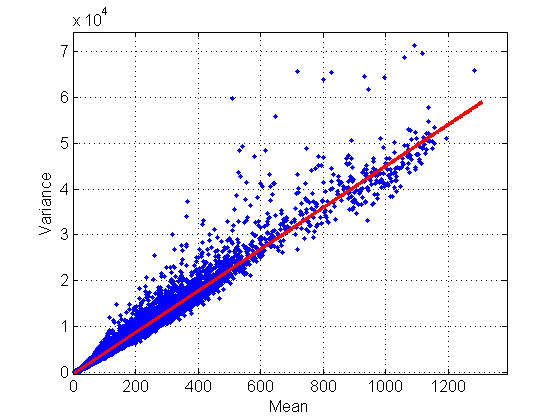
Briefly, as described in more detail by Labrigger, you take the mean and the variance of the image, divide one by the other and get the gain (i.e. one detected photon translates into an increase of how many pixel values). This value should not be lower than 1. This gain then allows to calculate the number of photons that arrive at a single pixel.

Instead of using a homogeneous frame as proposed by Labrigger, I used a simple rhod-2 injected brain sample, but I calculated mean and variance of a pixel not spatially over the image, but temporally within each pixel, thus having a) a realistic sample and b) more statistics. Plotting variance against mean allows to fit a straight line, the slope of which gives you the gain.

Fitting var/mean: gain ~ 45.

Fitting var/mean for all pixels of a 512×512 image with a resulting gain ~ 45. System: A standard Hamamatsu PMT, a Femto DHCP preamp, and an Alazar ATS-9440 DAQ board with the input range set to 0.2 V (0.2 V translating into 13 bit).

The calculated gain (ca. 45) is fine … although the real gain might be lower due to multiplicative noise that undermines the assumption of Poisson noise (for a discussion see the above-mentioned post by James Pawley). Additionally, this is a living sample, with moving fluorophors adding to variability in time. Still, I like the idea of using a simple movie of a sample as I use it all day.

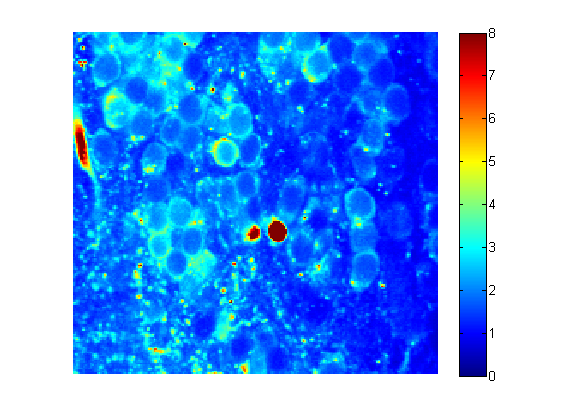
The gain then allows to calculate the number of photons per pixel (see again Labrigger’s post for more details). Here it is:

Estimate of numbers of photons per pixel; excerpt of the 512x512 image series used for generating the above plot. The bright (red) spots are blood vessels and not of interest.

Estimate of numbers of photons per pixel; excerpt of the 512×512 image series used for generating the above plot. The bright (red) spots are blood vessels and not of interest.

Looks like I’m getting around 2-6 photons per pixel for cytoplasm (rhod-2 staining). I was sampling at 80 MHz and binning pixels 8x (4096 sampling points per line to 512 pixels). For real experiments, I want to go to larger images, with binning reduced to 2x, at hte same time reducing the number of photons per pixel to less than 3. – But there would still be room left to increase the laser power and therefore the photon yield. Additionally, as mentioned above, I possibly overestimated the gain by factor which might be even as big as 2, which would increase the real number of detected photons per pixel by the same amount. In the end, this does not really matter, if the real data look bad/nice anyway; but it’s nice to count in physical numbers.

Posted in Uncategorized | Tagged , , | 1 Comment

Colormaps (without colorspace theory)

The labrigger blog keeps posting links to all kind of colormaps, so I tried out some of them. Being partially colorblind, I do not like the default colormaps e.g. of Matlab. Here are some noisy data, with two different scalings for each colormap.

A: Matlab default until recently (jet). B: One variant of CubeHelix. C: Colorbrewer. D: Colorbrewer. E: Grayscale.

A: Matlab default until recently (jet). B: The default variant of CubeHelix. C: Colorbrewer ‘diverging’. D: Colorbrewer ‘sequential’ 2. E: Grayscale.

Actually I like none of them. I find data much more accessible if they are presented as 1D plots, unless they are smooth and beautiful. Since I’m partially colorblind, I especially do not like A and C, which have strange parts in the middle part of the colorscale. I never liked the green and turquois part of “jet”. B looks like tree bark to me, to be honest. D and E are both fine for me, but I’d prefer D because of the more beautiful colors.

Posted in Uncategorized | Leave a comment

The excitation PSF in 2P point scanning

For quite some time, I was unsure about the reasons why images degrade when going to deeper layers with 2P point scanning. This also has remained largely unclear to me until the present point, after having done the estimates presented below, but at least now I’m getting a feeling for it.

The first difficulty lies in estimating whether the degradation comes from a degradation of the excitation PSF, or from low signal due to fluorescent photons that do not reach the detector due to scattering. The mean free path is around 200 um for the IR excitation light, and around 50 um for the to-be-detected visible light. Continue reading

Posted in Uncategorized | Leave a comment

Odd opinions in neurobiology

I have the impression that neurobiology is the single field in biology where many people with sometimes rather selective knowledge of the field have strong opinions about how it should work (i.e. how the brain should work). I don’t want to say that these opinions are worthless. In contrary, I enjoy them as an inspiring read that can question some of my beliefs that trickled down during the last years due to habituation. As a common sign, these theories present their new approach as a game-changer that offers a – until now – overlooked point of view on the brain. Nobody should be surprised by this, since, despite all efforts, an understanding of how specific information processing in the brain could look like is somewhat completely dark, and the most likely explanation for this lack of progress in understanding is a generally misguided paradigm in neurobiology, and the solution would be a paradigm change.

One example for a strong opinion I came across roughly two years ago, was the blog neuroelectrodynamics.blogspot.ch. (The author of the blog is apparently a professional neuroscientist.) On his blog, he highlights the importance of spike shape and propagation direction, and the possibility that these details of ion currents may lead to computations in neurons that are far more sophisticated than computations possible for simple firing rate models. It’s an interesting read, because it questions common places in neuroscience, although some of these opinions (firing rate models) are not necessarily part of the way most neuroscientists think of information processing anymore.

[Update 2018.] One example I came across recently is the blog mythsofvisionscience.wordpress.com, which questions the underlying assumptions that are driving the field of vision neuroscience (especially V1). It does not come up with a own crackpot theory of how the visual system should work, but instead points out many small and big weaknesses and flaws of current research in vision neuroscience. The blog is run by Lydia Maniatis.

Another (very different) example I found recently in the web is this homepage written in german: www.straktur.de It’s also available in english, but I have the feeling that it has been translated using Google Translate …
It stems from a mathematician who emphasizes the role of Glia cells; more precisely, he hypothesizes that Glia cells, responsible for nourishing neurons, evaluate the performance of neurons and support them accordingly. A dysfunctional neuron would therefore simply be discarded by cutting the support coming from Glia cells. By this, optimized information processing would arise naturally from this simple energy constraint (and this is where you can see the handwriting of a mathematician) – a basically interesting idea.
The author doesn’t really explain how the Glia cells might be able to evaluate the performance of surrounding neurons, but for simple circuits, one can imagine that this is possible.

At least for me, those kind of opinions are sometimes much more inspiring than a typical Nature/Neuron/Cell paper, because the presented opinion is strong, wants to convince he reader, questions the authorities in the field and often presents its theory as the holy grail, reminding you that there is something bigger out there (the holy grail) and that there is still a lack of understanding when it comes to specific information processing in neurons (or glia).

Posted in Uncategorized | Leave a comment

Genetically encoded voltage sensors

Genetically encoded calcium indicators (GECIs) are nowadays commonly used to report activity of many cells in transgenic animals; similarly, injected dyes like Rhod-2 can act as optical calcium reporters. The main shortcoming of this method is that it measures neuronal activity indirectly (via the calcium concentration), and, which is partially connected to the latter fact, at low temporal resolution (rise and decay times between 20 and 100 ms, or even more).

How nice would it be to have a genetically encoded fluorescent protein that changes its fluorescence not in response to calcium concentration, but to the electrophysiologically more relevant observable, the transmembrane voltage, better known as membrane potential. Indeed, these proteins exist. A number of recent papers made me aware of this fact; this week, I gave a short Journal Club about these indicators, and here I want to briefly summarize what is, according to my best knowledge, the state of the art.

Continue reading

Posted in Uncategorized | Leave a comment