During the lockdown in 2020, I was forced to stop my own experiments in the lab. This is when I turned to computational and analysis side-projects that since then have become quite central to my own work and approach to science. It was then that I teamed up with Anna Maria Reuss, then PhD student in the lab of Adriano Aguzzi, to work on the analysis of her massive 3D light-sheet imaging data from cleared brains.
Anna Maria developed a method that enables the use of large archival human tissue – non-perfused, and embedded in FFPE for more than ten years -, making it transparent, compatible with antibody labeling, and therefore suitable for imaging at large scale and micrometer resolution.
When you consider the sheer number of such FFPE samples stored in diagnostic archives worldwide, it is clear how powerful this approach is, and how many new lines of research it could enable. Here’s a link to the updated preprint: aDISCO: A clearing method to enable 3D microscopy of large archival paraffin-embedded human tissue blocks.
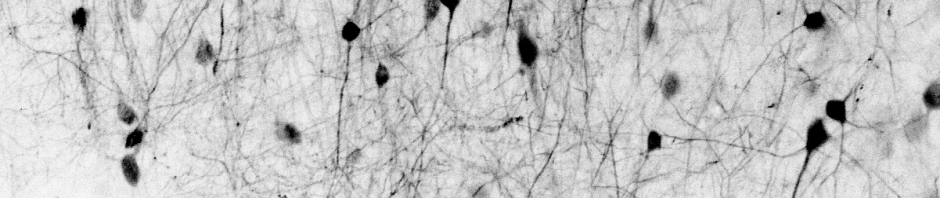
I’d like to take the opportunity to share this brief movie of a small excerpt of a cleared human brain (dopaminergic neurons in the substantia nigra) that we include in this most recent version of the manuscript to showcase how fine dendrites are resolved:


 A blog about neurophysiology