Calcium indicators are used to report the calcium concentration inside single cells. In neurons, calcium imaging can be used as a readout of neuronal activity (action potentials). However, some calcium indicators like GCaMP transform the calcium concentration of a cell into a fluorescence trace in a non-linear manner, following a sigmoidal curve:

This means that a small change in calcium concentration (ΔC1) may increase the fluorescence (ΔF1) only slightly, while the same change at a higher starting calcium concentration (ΔC2) leads to a much more prominent increase (ΔF2).
What many people do not consider is that this property has an effect on complex events with multiple bursts or action potentials in a sequence. The first spikes may only elicit small fluorescence changes, while the later spikes – with a large fraction of calcium ions still bound to the calcium indicators – result in much higher fluorescence changes. As a consequence, this results in a history-dependent bias that underestimates the early and overestimates the late phases of neuronal activity, as demonstrated with these simulated data:
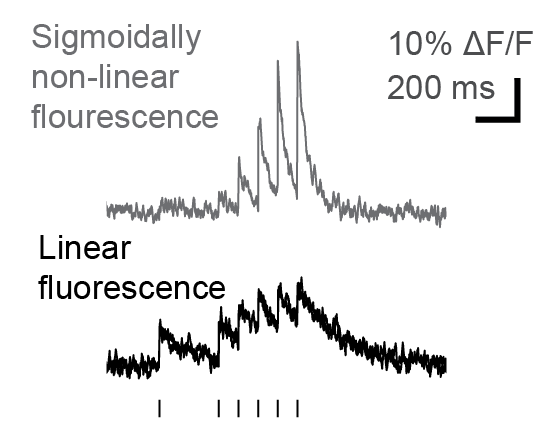
Simulated fluorescence traces for non-linear sigmoidal (top, gray) and linear (bottom, black) transfer curves. From Rupprecht et al, 2025, under CC BY 4.0 license (Figure 3d).
It is striking to see that for the non-linear calcium indicator, the first spike is barely visible, while the later ones are disproportionally amplified compared to the linear fluorescence trace.
Such history-dependent effects are also important to keep in mind when comparing the neuronal activity dynamics across calcium indicators. GCaMP6f, for example, is highly non-linear, showing a strong history-dependent effect. GCaMP8m, on the other hand, seems to behave more linearly in cortical pyramidal neurons. Therefore, dynamics of complex events cannot be compared across these calcium indicators without taking these effects into account. And spike inference (e.g., using CASCADE) must also take these history-dependent effects into account!
Read more about this (and several other related analyses!) in Figure 3 of our new preprint: Spike inference from calcium imaging data acquired with GCaMP8 indicators.


 A blog about neurophysiology